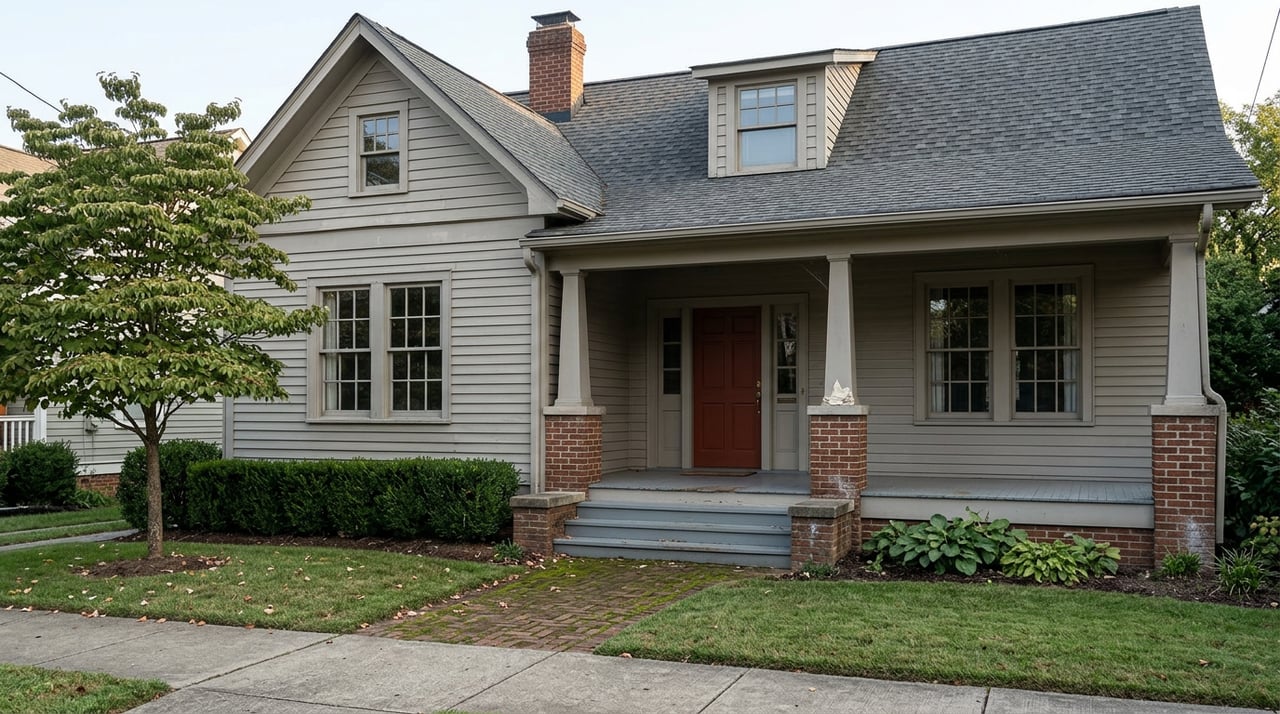
A buyer I was recently talking through options with had already fallen for a cottage on one of Hilton Village's quiet, tree-lined streets. The inspection came back clean enough to move forward, but it flagged the usual suspects for a home built in the 1918 to 1921 window: some knob-and-tube wiring still live in a back bedroom, an aging window or two with rotted sash cords, a roof nearing the end of its service life. Nothing unusual for a hundred-year-old house. The buyer's plan was straightforward: close, then fix these things on a normal timeline, the way you would in Denbigh or Kiln Creek or any newer Newport News subdivision.
That plan runs into a wall the moment it touches the exterior of the house. Hilton Village is one of two historic districts in Newport News with its own architectural review board, and that board has real authority over what a homeowner can do to the outside of a house, on a schedule that does not bend for a closing date.
The Price Everyone Notices First
Hilton Village's appeal starts with a number. Recent closed-sale data in the neighborhood has put the median sale price somewhere in the mid-$200,000s, noticeably below the broader Newport News citywide median, which has been running closer to $307,000 to $309,000 as of early 2026. Homes here have also been moving fast, with days on market compressing well below a year earlier in some recent reporting periods.
Read on its own, that looks like a straightforward value story: walkable historic district, English cottage architecture, a 60-acre waterfront park at Huntington Park, and a Main Street of local shops and restaurants along Warwick Boulevard, all for less than the average house in the rest of the city. For buyers relocating from more expensive markets or military families weighing options near Joint Base Langley-Eustis, that combination gets attention fast.
But a lower price per square foot in a 500-house district built between 1918 and 1921 is not free money. It is priced, in part, for age and for restriction. The houses are smaller, the systems are older, and unlike almost anywhere else in the city, what you're allowed to do about it is not entirely up to you.
What the Inspector Almost Always Finds
Newport News home inspectors who work regularly in the city's oldest neighborhoods describe a consistent pattern in Hilton Village and the nearby North End: foundation settling typical of century-old construction, knob-and-tube wiring still present in some homes, galvanized steel plumbing approaching or past its expected service life, and electrical panels that predate modern code. None of this is a reason to walk away from a house. It is simply what you expect to find in a neighborhood built for shipyard workers during World War I and largely unchanged in footprint since.
In most Newport News neighborhoods, a buyer who inspects a house and finds these issues has a fairly open path. Rewire it, replace the panel, swap the windows for something more efficient, put on a new roof in whatever material fits the budget. The work still needs a city permit, but the design choice is the homeowner's.
Hilton Village changes that equation for anything visible from the street.
What the Architectural Review Board Actually Controls
The Hilton Village Architectural Review Board was created by Newport News City Council in 1972, three years after the neighborhood was placed on the National Register of Historic Places in 1969. It is a real city body, staffed by the Planning Department, and it has the authority to review new construction, additions, fences, signs, and exterior alterations within the historic district.
The board's own property owner guidelines get specific in ways that surprise people who assume "historic district" just means older houses on a pretty street. A few examples straight from the city's guidelines document:
| If you want to... | What the guidelines say |
|---|---|
| Repaint the body of your house white | No board review required, since white is the original Village color |
| Repaint the body any other color | Requires board approval, and for duplexes both units need complementary colors |
| Replace windows | Must match the original in placement, size, and number of panes, since original Village windows were wood, double-hung or casement |
| Add a skylight or roof vent | Should not go on the front-facing roof plane, and should be located where it isn't visible from primary views |
| Install solar panels on an original slate roof | Considered detrimental to the historic district and generally discouraged, though the board may approve panels not visible from the public right-of-way on a case-by-case basis |
| Add or modify a fence | Requires board approval for changes in height, material, or color |
None of this is arbitrary. It is the same enforcement that keeps a neighbor from putting vinyl siding over a 1920s Tudor Revival cottage, which is a large part of why the streetscape still looks the way it did a century ago. But it means the inspection findings that would be a weekend project anywhere else in Newport News become a Planning Department application in Hilton Village.
Why the Calendar Matters More Than the Contractor
Here is the part that catches people off guard after closing. The board meets on the second Wednesday of each month, and meetings can be canceled entirely if no applications have been submitted. Getting on that agenda takes a complete application filed with the city's Planning Department well ahead of the meeting date. Miss the window and the next opportunity is a month away.
Separately, general building permit guidance for Newport News notes that exterior alterations visible from the street in the Hilton Village historic district need sign-off from the review process before a building permit can even be issued, which adds an extra review step on top of standard plan review timelines. Routine residential projects such as decks or fences typically clear plan review in five to fifteen business days elsewhere in the city. In Hilton Village, that clock does not start until the board has had its say, and the board only convenes once a month.
For a buyer who closes in October and expects a new roof or replacement windows installed before winter, this is the detail that resets the schedule. It is not that the work can't get done. It is that the sequence looks different than it would three miles away in Denbigh, and a renovation budget built around a contractor's calendar alone will run into a city calendar it did not account for.
The Trade You're Actually Making
None of this makes Hilton Village a harder place to own a home than it looks. It makes it a different kind of ownership than a newer subdivision, one where the tradeoff is spelled out up front instead of discovered later. You give up some autonomy over exterior choices and accept a slower timeline for certain repairs. In exchange, you get a level of protected consistency that keeps the neighborhood's character, and by extension its desirability, intact. That is part of why the streets still look like a coherent 1920s village instead of a patchwork of renovation decisions, and it is part of what keeps buyers coming back to a walkable district with a Saturday farmers market, a handful of long-standing Main Street restaurants, and a direct path to Huntington Park's beach and fishing pier.
The point isn't that the restrictions are a problem. It's that they belong in the same conversation as the price per square foot, not left for the first Planning Department phone call after closing.
A Few Questions Worth Asking Before You Write an Offer
Does the review board control anything inside the house? No. Its authority is limited to exterior work visible from the street and public right-of-way. Interior renovations, including electrical and plumbing replacement, go through the standard city permitting process without the added historic district layer.
Is every exterior change subject to review? Not every one. Repainting the body white, for instance, needs no review under the current guidelines since it is the original Village color. Most other visible changes, from window replacement to fencing to roofing material, do require an application.
How far in advance should a buyer plan for exterior repairs? Given the monthly meeting cadence and the added review step ahead of permit issuance, it is worth building in extra weeks beyond what a standard Newport News renovation timeline would require, especially if a repair needs to happen before a change of season.
If you are weighing a Hilton Village cottage against a newer home elsewhere on the Peninsula, that comparison is worth having with someone who has actually walked a buyer through this exact process, not just the listing photos. That is the kind of groundwork Amber Gentille does before you ever write an offer. Let's Connect.